Celebrity workouts often look like they need a private gym, a personal trainer and a room full of equipment. The truth is that many trainers build their clients’ routines around a handful of simple movements, and most of those movements can be done at home with little more than your own bodyweight, a pair of dumbbells and a resistance band. If you have been putting off strength training because a gym membership feels expensive or intimidating, starting at home is a perfectly good way to begin.
This beginner’s guide covers the equipment worth buying, the core movements to learn and a simple weekly plan you can follow.
Why Strength Training Is Worth Your Time
Strength training is not only for people who want big muscles. For most people, the appeal is more practical: feeling stronger in everyday tasks, improving posture, supporting an active lifestyle and building confidence in how your body moves. It also pairs well with walking, running or any other activity you already enjoy. You do not need long sessions to get started. Two or three focused workouts a week are enough for many beginners.
If you have an injury, a health condition or have been inactive for a long time, it is a good idea to check with a doctor or a qualified professional before starting a new exercise program.
Minimal Equipment Worth Having
You can begin with bodyweight alone, but a few affordable items add variety and let you keep progressing:
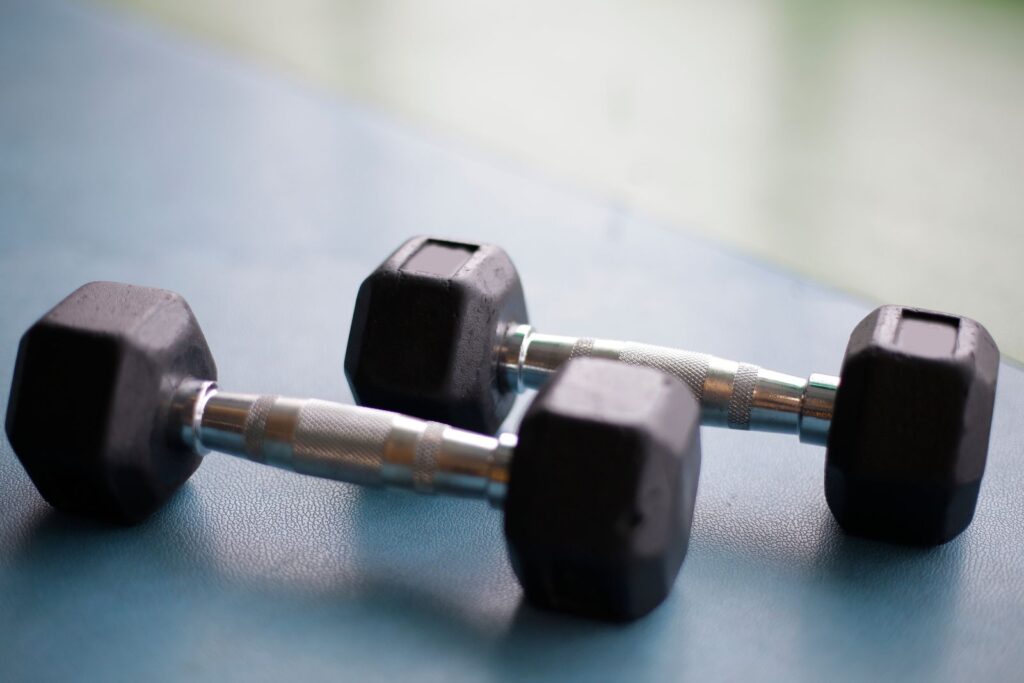
- A pair of adjustable dumbbells or two sets of fixed dumbbells. A lighter and a heavier pair cover most beginner exercises.
- Resistance bands. Loop bands and long bands with handles are inexpensive, portable and useful for upper body and glute work.
- An exercise mat. It makes floor exercises more comfortable and marks out your workout space.
- A sturdy chair or step. Handy for step ups, split squats and incline push ups.
Optional extras such as a kettlebell or a doorway pull up bar can come later, once you know you enjoy training at home.
The Six Movements to Learn First
Most strength programs, including many celebrity routines, are built around a few basic movement patterns. Learn these well and you have the foundation for almost any workout.
1. Squat
Stand with feet about shoulder width apart, sit your hips back and down as if lowering onto a chair, then stand back up. Start with bodyweight and progress to holding a dumbbell at your chest, a variation often called the goblet squat.
2. Hip Hinge
The Romanian deadlift with dumbbells teaches you to bend from the hips with a flat back, a movement that works the back of the legs and the glutes. Glute bridges on the floor are a simpler alternative.
3. Push
Push ups are the classic home exercise. If a full push up is too hard, start with your hands on a wall, a counter or a sturdy chair, and lower the height as you get stronger.
4. Pull
Bent over dumbbell rows or band rows work the upper back, which balances all that pushing and supports good posture.
5. Lunge or Step Up
Single leg exercises such as reverse lunges, split squats and step ups build leg strength and balance.
6. Core
Planks, side planks and dead bugs train your core to stay stable, which carries over to every other movement.
A Simple Beginner Plan
Try this full body workout two or three times a week, with at least one rest day between sessions.
- Goblet squat: 3 sets of 8 to 12 reps
- Push up (any variation): 3 sets of 6 to 12 reps
- Dumbbell Romanian deadlift: 3 sets of 8 to 12 reps
- Dumbbell or band row: 3 sets of 8 to 12 reps per side
- Reverse lunge: 2 sets of 8 reps per leg
- Plank: 3 holds of 20 to 40 seconds
Rest about 60 to 90 seconds between sets. Begin every session with five minutes of light movement, such as marching in place, arm circles and bodyweight squats, to warm up.
How to Keep Making Progress
The key to getting stronger is gradual progression. Once an exercise feels comfortable for all your sets, make it a little harder:
- Add a few reps to each set
- Use a slightly heavier weight or a stronger band
- Slow down the lowering part of each rep
- Move to a harder variation, such as from incline push ups to floor push ups
Change only one thing at a time, and keep a simple log of what you did each session so you can see your progress.
Common Beginner Mistakes
- Doing too much too soon. Starting with fewer sets and building up helps you stay consistent.
- Rushing the reps. Controlled, steady movements are better than fast, sloppy ones.
- Skipping the warm up. A few minutes of movement prepares your body for the workout.
- Chasing variety over consistency. Repeating the same solid routine for several weeks is what builds strength.
- Ignoring pain. Normal muscle effort is fine, but sharp or unusual pain is a signal to stop and get advice.
Conclusion
You do not need a celebrity budget or a fancy gym to start strength training. A small space, a few pieces of affordable equipment and six basic movements are enough to build a routine that makes you feel stronger and more capable. Train two or three times a week, progress gradually and stay consistent. The results come from showing up, not from how much equipment you own.